

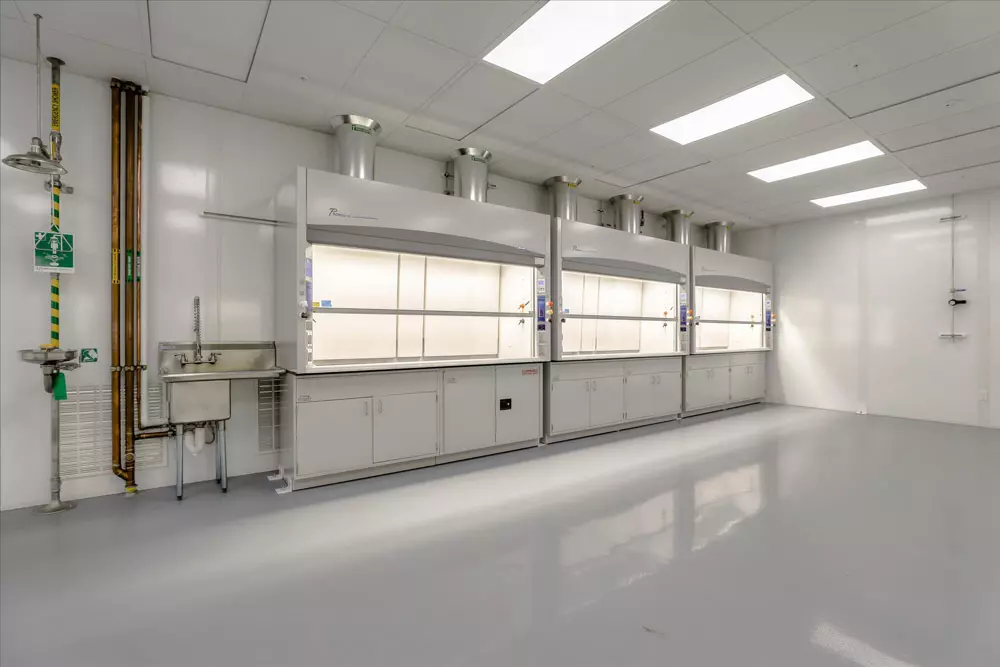
Your cleanroom’s positive pressure system is only as effective as the physical envelope surrounding it. You can have a perfectly designed HVAC system with calibrated fan-filter units and a meticulously planned pressure cascade, but if there are gaps in the wall system, the air will find them. When that happens, the differential falls and ISO compliance becomes the next challenge on the list.
Positive pressure works by supplying filtered air into the cleanroom at a higher volume than is exhausted. That pressure gradient forces air outward at any gap or opening, keeping contaminants from drifting in. It is a straightforward principle, and one that only holds as long as the physical envelope surrounding the room is properly sealed. That envelope is the wall system, and how well it is sealed determines whether positive pressure works in practice.
This article gives you the specifics behind each: enough to know what good looks like before installation begins and what questions to ask of whoever is building your cleanroom.
The wall system’s job is simple in principle: make sure every opening is a controlled one.
In semiconductor support environments, typical pressure differentials run between 0.05 and 0.08 inches of water gauge between the cleanroom and adjacent gowning or airlock spaces, with the same range between gowning and the surrounding uncontrolled environment. These are modest numbers. Maintaining that differential is vital to keeping a positive pressure environment intact, and a properly sealed wall system is what makes it possible without overworking your HVAC. When the seal fails, facilities typically compensate by running equipment harder than designed or overbuilding the air handling system. Both are costly solutions to what is fundamentally an envelope problem.
The wall system is the envelope. Every joint and every penetration in that system is a variable that has to be managed. Working with an experienced cleanroom partner means those variables are addressed before they become problems, protecting your investment and keeping operations running without interruption.
In any modular wall system, four joint types determine whether the pressure envelope holds, and each one has to be addressed deliberately at installation. These four locations are also the fastest diagnostic path when an existing cleanroom is losing differential.
Panel-to-panel joints are the most numerous seal points in any installation. In Starrco’s friction-fit system, the panels seat tightly against each other by design, but the critical step is applying a facility-approved, cleanroom-grade sealant at every joint. Every joint. A run sealed at 90% still leaves air paths at the remaining 10%. One note for semiconductor environments: sealant chemistry has to be confirmed with the facility team before installation, since off-gassing from certain products can interact with manufacturing processes.
Panel-to-floor track is the one joint where incomplete sealing is hardest to spot and easiest to overlook during installation. If the seal is spot-applied at corners or skipped where access is inconvenient, air travels below the wall rather than through controlled openings. Check here first when a cleanroom is losing its differential.
Panel-to-ceiling grid is harder to inspect once ceiling components are in place. Sitting directly in the air handling path, it has to be sealed before ceiling work proceeds. Trying to address it afterward produces inferior results.
Panel-to-door frame is its own joint category, separate from the door’s sealing components. Every frame-to-panel interface needs the same sealant treatment as any other joint in the system. A common field assumption is that the door’s gaskets will compensate for a poor frame seal. They will not.
There is a persistent perception in some facility circles that mechanical gasket systems are more reliable than sealant-based approaches because they feel more standardized. Long-term performance complicates that assumption.
Mechanical gaskets compress under the weight and contact pressure of the wall system. With time and thermal cycling, that compression becomes permanent. At that point, the gasket no longer fills the gap it was designed to seal and the joint starts to work loose. Eventually someone has to return to replace or reseal, which is another maintenance item on your list.
A properly applied cleanroom-grade sealant bond works differently. As it cures and conforms to the joint geometry, it improves. The material takes on the shape of the surfaces it bonds to, and any inherent tackiness in the gasket material reinforces that bond over time rather than degrading it.
Of all the variables in a cleanroom wall system, penetrations are among the most important to get right. A gap that is sealed at every panel joint but left open at a conduit penetration undermines everything else.
Every penetration in the wall envelope is a potential failure point. Any conduit or line punched through that envelope creates a gap that has to be managed. When penetrations are planned before installation and sealed as part of the build sequence, they can be handled correctly and completely. The problem is what happens after the fact. A conduit knocked through the wall six months after certification, with the gap filled inconsistently or left open because it was treated as a minor detail, is a pressure loss waiting to happen.
Starrco’s design and installation process addresses penetration locations before crews arrive on site, so those gaps are sealed as part of the build sequence rather than corrected after the fact.
Doors are the highest-traffic seal points in any cleanroom because they are designed to open. Managing that tension starts with the frame gasket and threshold seal, both of which need continuous contact with the door panel across the full perimeter. A seal that lifts at one corner or compresses into a gap is creating an air path rather than closing one.
Door swing direction also plays a role: doors should swing into the higher-pressure space so the differential works in the seal’s favor.
Airlock interlock systems handle what happens when doors are open. If both doors in a sequence open at the same time, the pressure cascade between zones collapses. Interlock systems, whether electronic or mechanical, prevent that by ensuring only one door can open at a time. Electronic interlocks are the most common configuration in semiconductor support environments, though the right choice should always reflect the room’s actual operating conditions. A facility with a small, consistently trained staff has different needs than a large operation with rotating shifts.
A cleanroom sealed correctly at installation can still develop integrity issues over time. Modifications for new equipment and penetrations added after certification are two of the most common contributors. Continuous monitoring is how you catch those issues before they become compliance events.
Pressure differentials should be monitored at each zone transition: cleanroom to gowning or airlock, and gowning to uncontrolled environment. Magnehelic gauges are the traditional choice and perform reliably in most applications. Electronic differential pressure monitors offer continuous data logging and alert thresholds, which is particularly valuable in facilities where the space is not being physically walked every day.
A differential drop is the first signal that seal integrity is slipping, and it shows up on the gauge before particle counts are affected. In most cases, it is a slow drift. It may have started with a penetration sealed poorly, or a threshold seal beginning to compress out of profile. Catching that drift early means a targeted repair, perhaps a few hours of remediation work. Missing it means particle counts start climbing, and eventually you are looking at a formal requalification event rather than an afternoon of corrective action.
When a semiconductor cleanroom loses pressure integrity to the point where particle counts exceed its ISO classification, production stops. The facility cannot resume operations until a full requalification is complete: remediation and retesting, followed by certification and documentation. Testing fees and documentation add up quickly, but the largest cost is the production time lost while the line sits idle.
This is why Starrco treats wall sealing as a system specification rather than a construction detail. Penetration planning and sealant selection happen before crews arrive, so every joint is sealed correctly during installation. Whether you are designing a new semiconductor support cleanroom or validating an existing one, Starrco has been engineering modular cleanrooms for semiconductor suppliers and equipment refurbishers for decades. Contact our team to get a quote or talk through your specific design.