

If you’ve been selling into industrial facilities for any length of time, you already have something valuable: a book of customers who trust you. They call you when they need equipment. They take your recommendations.
And if the majority of your business consists of racks, forklifts, conveyors, and similar equipment, you’re leaving a significant opportunity on the table to engage on larger projects.
Dust containment is one of the more significant untapped opportunities sitting inside existing dealer accounts right now. Dry material handling compliance pressure is growing and the customers who need a solution are often the same ones already in your pipeline. This guide is designed to help you spot those opportunities and confidently offer modular solutions to your customers.
When a facility manager finally decides to address a dust problem, there’s a whole range of options in front of them and most don’t know which is right for their application. They need someone who can help them think it through. That’s where you come in.
Understanding the landscape of options makes you a more credible resource in that conversation.
Dust control typically starts at the source. The most effective first line of defense is a ventilation or dust collection system designed to capture particulates as close to the point of generation as possible. Think hoods, capture arms, or downdraft tables positioned right at the machine. For many applications, this alone can bring exposure levels into an acceptable range.
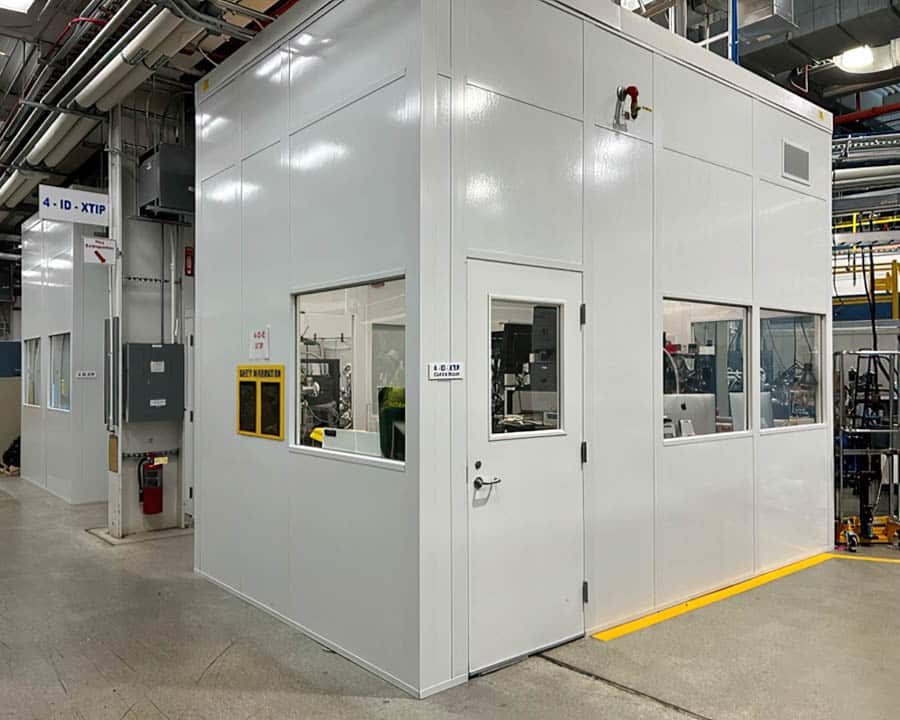
A modular enclosure is the next layer. When source capture alone isn’t sufficient, or when the process generates dust in a way that’s difficult to fully capture at the point of origin, an enclosure creates a physical barrier around the entire operation. Combined with a ventilation system pulling air out at negative pressure, the enclosure contains what the source capture doesn’t catch.
In practice, most well-designed dust containment solutions use both. The enclosure is Starrco’s part of that equation. The ventilation and dust collection system is handled by a specialist partner. Helping your customer understand how these two components work together is part of what makes you useful early in the process.
Once a customer decides to act, their first instinct is often to call a contractor. It’s what they know. They usually know what this is going to entail and are bracing for how it will impact production: coordinating trades, managing a construction timeline inside an active facility, permitting a permanent structure. What they don’t know is that there’s another way: Modular.
Once a customer is open to modular, they’ll want to compare options. This is where your guidance matters most.
Other modular suppliers may appear comparable on the surface, but the differences show up in the details: panel precision, engineering support, and what happens when something goes wrong during installation. The customer who has a problem on the job site doesn’t call the manufacturer. They call you. And the right modular partner is there to support you every step of the way.
Starrco’s reputation in the industry is built on fit, finish, and follow-through. Every project ships with complete CAD drawings. Panels are precision-cut and labeled. Stamped engineering calculations are included for permitting if needed. And if something comes up on site, installation experts are available to help resolve it. That level of back-end support protects your relationship with the customer and your reputation as the rep who brought them the right solution.
You don’t need to be a dust containment engineer to sell this product. Knowing the key design elements helps you speak credibly when a customer starts asking technical questions. Here’s the vocabulary that matters.
Negative pressure. A properly designed dust containment enclosure operates at negative pressure relative to the surrounding facility. This means air is drawn inward toward the dust collection system rather than allowing contaminated air to leak out. An enclosure that isn’t properly sealed or ventilated can actually make things worse by creating unpredictable airflow, so this design detail matters.
The extraction system. Starrco provides the envelope, which is the modular structure itself. The dust collection system (the fan, the collector, the filtration) is designed and installed by a dust collection specialist. The two have to work together, which is why getting that partner involved early in the design process matters.
Wall and ceiling finishes. Starrco enclosures for dust applications include durable, easy-to-clean wall finishes, solid surface ceiling tiles, and proper caulking throughout to seal the envelope as tightly as possible. Gaps and penetrations are where containment fails, and the design accounts for this.
Visibility. Operators typically need to see into the enclosure for safety and process oversight. Window options include tempered safety glass, laminated safety glass, acrylic, and shielded glass. The right choice depends on the application. Laminated glass, for example, is preferred in food processing environments because it doesn’t shatter into fragments.
Make-up air. Grinding and milling operations generate heat. A properly sized make-up air system, matched to the ventilation pulling air out, ensures the temperature inside the enclosure stays at a workable level for operators. This is something the dust collection partner handles, but worth knowing when the customer asks about working conditions inside the enclosure.
When to bring in an EHS officer. Not all dust is the same. Nuisance dust from grinding steel is a different conversation than potentially hazardous particulates from certain chemical or material processes. Starrco’s strong recommendation is that any customer generating process dust consult with an Environmental Health and Safety officer to establish the right safety protocols. If your customer doesn’t have one, that’s a useful thing to surface. It signals you understand the full scope of what they’re dealing with.
Permitting is one of the most common reasons dealers hesitate to bring up modular enclosures. It sounds complicated. In practice, it’s much more manageable than most people expect, and in some cases it isn’t required at all.
Here’s how to think about it and what to expect.
This is the first question to answer. Modular panelized wall systems are frequently classified as equipment rather than permanent structures, which means they may not require a building permit at all in a given jurisdiction. The rules vary by county and municipality, so the best first step is for your customer to check with their local building officials before assuming a permit is needed.
If a permit is required, proceed to the steps below.
Starrco provides a documentation package with every project designed to support the permitting process. Depending on what the local AHJ requires, this typically includes:
In many cases, the stamped drawings and product specifications are all that’s needed. For more complex jurisdictions, Starrco can also support architectural drawing requirements.
Before submitting anything formally, Starrco strongly recommends meeting with the local building official early in the process. This conversation accomplishes two things: it confirms exactly what documentation they need, and it gives you the opportunity to introduce them to the product if they’re not already familiar with panelized wall systems.
Bring product samples if you have them. Some building officials haven’t reviewed this type of construction before, and having a physical panel to reference makes the conversation much easier.
This is a detail that matters more than most people realize. Using the wrong terminology with a building official can create confusion and slow the process down. Here’s what to use and what to avoid:
Use these terms:
Avoid these terms:
Once documentation is submitted, approval timelines vary by jurisdiction. Some move quickly, others take longer depending on the municipality’s workload and familiarity with panelized construction. Your Starrco territory manager can give you a realistic sense of what to expect in your region based on past projects.
The key is not to let permitting uncertainty become a reason to delay the project conversation. Get Starrco involved early, and let them help navigate the documentation side while you focus on the customer relationship.
| Lead time | 6–8 weeks, order to delivery |
| Quote turnaround | 24–48 hours from inside sales |
| Installation | Pre-cut, pre-labeled panels, typically 1–2 days on site |
| Framed openings | Factory-cut to spec, coordinated with dust collection contractor |
| Engineering drawings | Stamped CAD drawings included for permitting with every order |
| Tax depreciation | 7 years vs. 39 years for conventional construction |
| Support | Installation experts available for job site questions |
The opportunity is in your existing accounts. And we’ve built the back-end support to make this process as straightforward as possible for you.
\If you have questions about this process or a specific project, we’re here to help! Get in touch with our dealer support team 800-325-4259.