

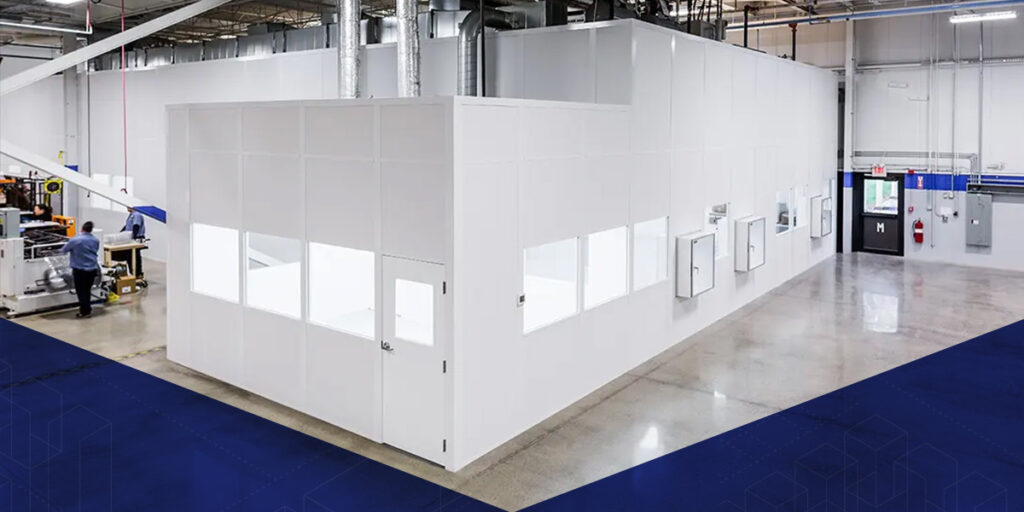
If you work in aerospace and you’ve been tasked with specifying or building a controlled environment, you already know the process is more complex than it looks on paper. You need to start production ASAP. And whatever you build today might need to look completely different in 18 months when the program changes.
Conventional construction is designed for permanence. Aerospace programs rarely are. The key is understanding what modular means for aerospace applications and what the build process looks like from start to finish.
This article covers the construction process, the design decisions that matter most, and what to expect when working with a modular partner on an aerospace controlled environment project.
Before we dive into the build process, let’s first take a look at the different types of build that are common in aerospace. This is probably the most important thing to understand before you spec anything out: aerospace controlled environments span a much wider range of applications than most industries. The design for each one looks different.
When you’re assembling components that will eventually leave Earth’s atmosphere, precision and particle control are everything. You have to be able to certify with scientific certainty that components are manufactured to handle the harsh conditions of space. These rooms are built to specific air change rates and pressure relationships, with certified cleanliness levels ranging from ISO 5 through ISO 8 depending on the application. Gowning sequences are part of the protocol.
Many aerospace controlled environments focus on controlling temperature and humidity rather than particle counts. Carbon fiber bonding rooms are a good example. During the industry’s shift to composite materials, there was a significant wave of demand for rooms where composite layup could happen under controlled atmospheric conditions. The structure had to hold temperature and humidity within tight tolerances so the bonding process worked correctly.
Fighter pilot survival systems include oxygen-generating canisters that rely on lithium. Those canisters are manufactured in controlled environments that must keep relative humidity below 10 to 11 percent. If humidity climbs past that threshold, the lithium begins to coagulate and becomes unusable. The room’s job is protecting a material from moisture, which makes it a fundamentally different design conversation than a traditional cleanroom.
Foreign Object Debris (FOD) is a serious concern across aircraft and defense manufacturing alike. When a stray bolt or piece of debris ends up inside an engine or avionics assembly, the consequences can be catastrophic. FOD-controlled enclosures create a defined boundary around assembly operations to reduce those risks.
Each of these environments demands something different from the build. Wall performance and insulation requirements depend on the application. Filtration design and air handling strategies follow from those same decisions. A room designed to maintain sub-11% RH for lithium processing needs meaningfully more insulation than a standard office build-out. An ISO 7 cleanroom requires smooth, non-particulating wall surfaces that go beyond what a dry room specification demands. Getting that right starts with understanding the application before the first component gets designed.
Regardless of what type of controlled environment you need, the build process is the same. The process has four main phases, and the details within each one matter for aerospace applications specifically.
Before any drawings get made, we visit your facility. The goal is to understand the application and the environmental specification, along with the equipment footprint. We also need to know the facility itself. Seismic zone classification shapes the structural design. Lease terms often dictate whether the room can attach to the building. Adjacent programs set constraints on construction timing and methods. All of that gets surfaced at the beginning, and it all drives downstream design decisions.
Permitting gets addressed at this stage too. Requirements vary by jurisdiction, and some regions are less familiar with modular construction than others. Our engineering packages include stamped structural calculations and permit-ready drawings designed to address the questions reviewers most commonly raise, which keeps the process moving.
Every component is precision-manufactured off-site and ships with a complete CAD drawing set. Panels arrive pre-cut and pre-mitered, with no raw material finishing required on-site. For aerospace facilities where adjacent programs or live production need to keep running during a build, the cleanliness and speed of factory fabrication make a significant operational difference.
Modular construction installs up to 70 percent faster than conventional construction. For most projects, the window from order to delivery runs 6 to 8 weeks. For a program team managing a hard start date, a vendor that consistently hits that lead time is worth a great deal. Every week saved during construction is a week closer to production.
Starrco has built controlled environments for some of the most recognized names in aerospace and space exploration, including NASA, SpaceX, Boeing, Blue Origin, and McDonald Douglas. Our most recent SpaceX project was an ISO 8 cleanroom. We’ve also delivered freestanding controlled environments on the West Coast rated for Seismic Design Category D.
A meaningful portion of our aerospace work happens under NDA. We know what the project is and where it’s going. Sometimes that’s about all we know. Aerospace customers frequently prefer to keep the details of what’s happening inside a room private. If you’re working on something sensitive, that’s a normal conversation for us.
Every constraint that makes aerospace construction difficult is one modular handles well. Program deadlines are fixed. Seismic requirements are written into the design criteria. Whatever you build today will likely need to change as programs evolve. Modular construction is designed for that operating environment.
If you’re planning an aerospace controlled environment build and want to talk through what the process looks like for your specific application, request a quote. Our team provides initial estimates within 24 hours for most projects.
Ready to get started? Request a free quote from the Starrco team today.