

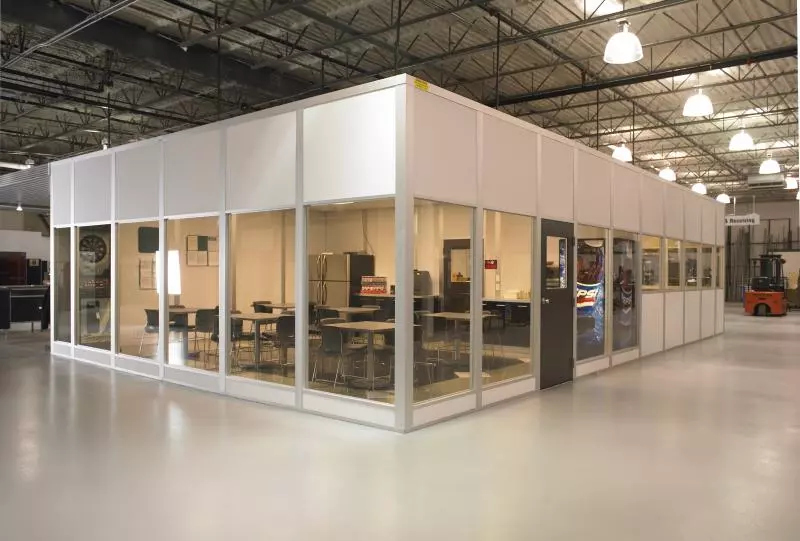
Most manufacturing facilities are designed around one thing: production. Floor plans are laid out with equipment, material flow, and throughput in mind. Office space, break rooms, and administrative areas are almost always an afterthought, squeezed into leftover corners or crammed against exterior walls. And as operations grow, so does the competition for space
When a plant manager runs out of space, the gut reaction is usually to build out. Add a wing. Lease more square footage. Push a wall back. But those options are expensive, slow, and permanent. They also pull your floor plan in the wrong direction, taking space from the areas where you actually make money.
A load-bearing modular office system changes that equation entirely. You get the workspace your team needs now, overhead storage capacity that keeps your floor clear, and the structural foundation to add a full second story when the time comes. No second construction project. No starting over when you need more space.
Floor space in any manufacturing environment is a finite, high-value resource. Every square foot you dedicate to an office, break room, or storage area is a square foot that is not generating production output. That math is always in the back of a plant manager’s mind, and it is why office space tends to get shortchanged until it cannot anymore.
When it is time to add workspace, a modular in-plant office is the right call. It installs faster, causes less disruption, and can be reconfigured or expanded in a way that conventional construction simply cannot. But not all modular offices are created equal. The difference between a standard modular design and a scalable one is the difference between solving today’s space problem and solving it for good.
A modular office that is not designed for load-bearing from day one is a dead end. When operations grow and you need more space, you are back to square one: tearing out what you built or working around it. A scalable design, one engineered with the future in mind, turns your initial investment into a foundation that grows with your operation and puts the vertical space already inside your facility to work.
A modular in-plant office is a precision-engineered building system, custom designed for your space, so that when components arrive at your location, they are precision cut, labeled, and ready to assemble. The result is a work-ready office that installs 70% to 75% faster than conventional construction, with minimal noise, disruption, or downtime to your operation.
But the decision that determines whether your modular office is a long-term asset or a short-term fix happens before installation begins: structural design.
A standard modular office is built to occupy space. A scalable one is built to support what comes next. Wall panels in a load-bearing system use insulated, impact-resistant construction with structural aluminum framing, commercial-grade 20-gauge steel doors, and ADA-compliant hardware throughout. More importantly, the wall system itself is engineered to carry the loads required to support overhead storage and, eventually, a full second story. That engineering decision costs far less upfront than a second construction project later.
On the financial side, modular buildings are classified as tangible personal property and depreciate over seven years rather than the 39-year schedule applied to conventional construction, a distinction that meaningfully accelerates your return on investment. Design for scalability from the start, and that return compounds even further.
The most common mistake in modular office planning is choosing a standard, non-load-bearing design because it costs less today. A team of four becomes a team of twelve. A single foreman’s office becomes a full administrative floor. What felt like plenty of space at installation starts feeling cramped within a few years, and facilities that chose a standard design face the same problem all over again: the building they installed cannot support a second story, so they are back to square one.
The SS3500 wall system is engineered to prevent exactly that situation. Two-piece wiring studs function as both structural columns and vertical wiring raceways, eliminating the need for additional support columns and keeping the interior clean and unobstructed. C-channels and I-beams reinforce 22-gauge steel B-decking rated to support loads of up to 125 pounds per square foot. The result: a single-story building installed today is a ready-made foundation for a second story whenever you need it, with no structural overhaul, no demolition, and no disruption to the investment you already made.
In practice, many customers install their load-bearing single-story building years before they ever need a second floor. When that time comes, the expansion attaches cleanly to the existing structure without disrupting day-to-day operations. That is how the system is designed to work from the start.
One of the most immediate advantages of a scalable modular office is the ability to use the space above it as functional square footage from day one, even before a second story is ever needed.
Once the B-decking is in place, the deck above your first-floor office becomes a usable storage platform. That space can support equipment, inventory, records and filing systems, material staging, or virtually any other storage function your operation requires. For many facilities, this is where years of accumulated clutter, parts bins, seasonal inventory, archived records, spare components, finally has a real home.
The critical benefit is what happens on the floor below: nothing changes. Your production floor stays fully dedicated to production. You have not sacrificed a single square foot of operational space to solve your storage problem. Instead, you used space that was previously doing nothing at all.
Consider a common scenario: a mid-sized manufacturer has an administrative team working out of a cramped corner office and a storage room overflowing into the production aisle. A load-bearing modular in-plant office solves both problems at once. The main floor of the structure houses the administrative offices, the foreman’s office, and a break room. The overhead deck stores equipment, inventory, and records. The production floor not only stays intact, it may actually free up aisle space that the overflow storage was encroaching on.
That is the compound benefit of designing for scalability from the start. The upfront engineering investment pays dividends immediately and continues paying them as the facility grows.
The decision to go two-story does not have to happen at installation, many customers add the second floor years later, when the need arises. A few conditions typically signal it is time.
The most obvious is running out of floor space. If your first-floor office is at capacity but expanding outward would eat into production space, a second story solves the problem without any footprint expansion. Supervision is another driver: from ground level, sightlines are constantly blocked by equipment and floor activity. An elevated office or observation platform gives supervisors a clear, comprehensive view of the entire operation, line flow, personnel positioning, safety compliance, from a sound- and temperature-controlled environment. Our insulated 3-inch walls and sound-tight construction block out industrial noise effectively, and elevation moves personnel even further from the loudest zones on the floor.
Two-story configurations also create room for conference spaces, expanded break rooms, and employee amenity areas that would otherwise be impossible to fit, without pulling a single square foot from production.
The first floor is built using the SS3500 load-bearing wall system, the second floor using the SS3000 system optimized for upper-story applications. The structural backbone uses freestanding aluminum alloy extrusions and structural steel I-beams that are independent of your facility’s existing walls, meaning the building can go anywhere on your floor plan and can be relocated or reconfigured later if your needs change.
Every staircase and landing is custom manufactured at our St. Louis facility and precision-engineered for the exact dimensions of your installation. Aluminum sliding doors and large observation windows give upper-floor personnel clear sightlines to the production floor below, while the sound-controlled wall systems keep noise and heat out.
The process runs three stages: facility consultation, design and fabrication, then delivery and installation. Every component is built in our controlled environment before it arrives on your site. Because the structural design was done right from the start, the second story goes up without touching what is already there.
If your facility has ample ceiling height but limited floor space, a load-bearing modular design lets you reclaim that vertical capacity right away and expand upward when the time comes. If you have storage needs that are eating into your production footprint, an overhead deck solves that problem without touching your floor plan. And if there is any reasonable chance that your operation will need more office, conference, or break room space in the next several years, designing for scalability from day one is far less expensive than retrofitting or rebuilding later.
Beyond offices, the same load-bearing system supports record-keeping rooms, conference and break spaces, equipment and material storage, and observation platforms. If your facility needs a coordinate measuring machine (CMM) room or a controlled environment for data and server systems, a scalable in-plant building can accommodate those applications as well, often on the same structure.
The Starrco team starts every project with a facility consultation. We visit your space, understand your production flow, evaluate your ceiling height and floor plan, and engineer a solution for your exact situation. Every project is custom, because the right design for a 10-by-10 office in one facility is a completely different answer from a 10-by-10 in another, once you factor in columns, mechanical systems, egress requirements, and where the operation is headed in the next five years.
If your manufacturing facility is running out of room, or if you want to get ahead of that problem before it affects operations, a scalable modular office built for load-bearing from day one is the most practical investment you can make. You solve the space problem now, maximize overhead space that would otherwise go unused, and set yourself up to add a second story when your operation calls for it.
Starrco has been engineering modular in-plant buildings since 1965. We provide accurate project quotes for most requests within 24 hours and can have your building designed, manufactured, and installed faster than any traditional construction alternative.Request your free quote today and find out what building up looks like for your facility.