

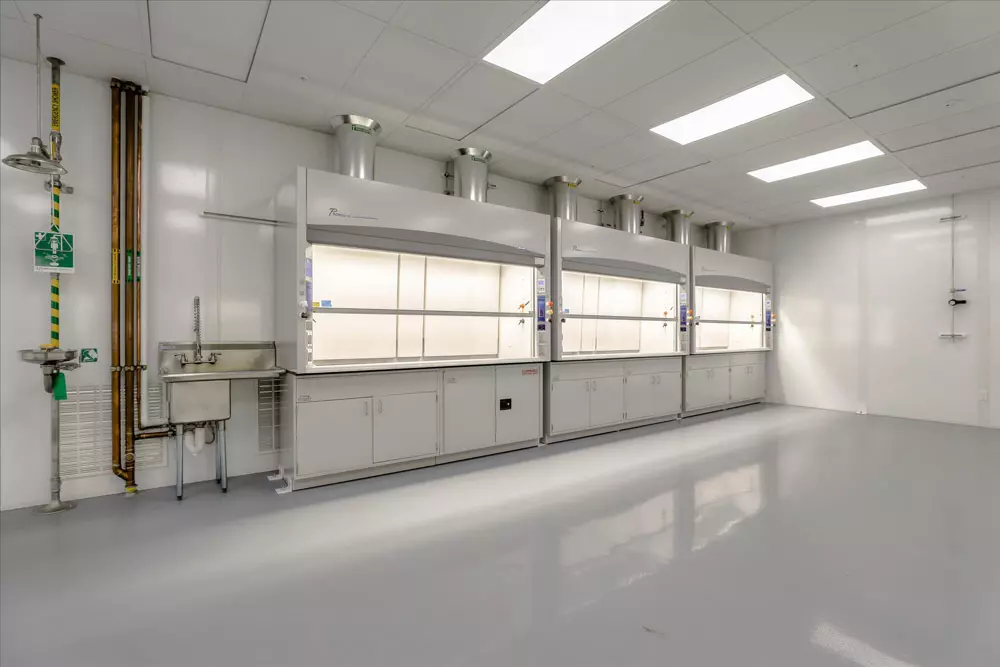
The semiconductor supply chain runs on precision. Every component, every surface, every process step is evaluated against exacting standards, which makes it all the more surprising that wall material decisions in cleanroom construction are so often driven by convention rather than application. The industry has been building cleanrooms the same way for a long time, and the knowledge that gets passed from one generation of engineers to the next tends to travel without much questioning along the way.
Aluminum has long been the go-to wall material for semiconductor cleanrooms, and it earned that reputation. For the most demanding controlled environments, it still makes sense. What’s changed is the range of alternatives available today, materials that meet the requirements of many semiconductor support applications without the complexity that aluminum brings. Knowing when aluminum is truly necessary, and when it isn’t, is where the real opportunity lies.
Why did aluminum become the industry standard for cleanroom walls, and does it still deserve that title? To answer that, it helps to take a quick look at how the industry got here.
The short version of history goes like this: the earliest cleanrooms were built from painted block wall, epoxy-coated for durability. As the industry matured and modular construction became more practical, steel panels took over — until fabricators realized that aluminum was easier to cut, lighter to work with, and more widely available. A large aluminum honeycomb panel industry grew up around semiconductor fabs, and aluminum cemented its place as the go-to surface.
Part of what makes wall material selection complicated is that the person in your facility making the cleanroom spec decision isn’t always doing it based on their own technical evaluation. Often, they were trained in cleanroom protocol by someone else, who was trained by someone else, and the “rules” they’re operating by haven’t been revisited in years. On top of that, their customers, the companies whose parts they’re servicing or packaging before those components head back into a fab, may have their own expectations about what a cleanroom should look like.
The practical takeaway: for ISO 5 environments and above, operating in or directly adjacent to a true fab, aluminum is well-justified. For the much broader world of semiconductor support facilities, wafer tool refurbishers, component packagers, cleanroom laundry operations, and assembly shops, there’s often significantly more room to work with than clients initially realize. The right wall material for cleanrooms in these applications deserves a real evaluation.
Not all wall materials perform the same way, and not all cleanroom applications demand the same performance. Here’s how the most common options stack up:
Vinyl is a standard wall panel surface, and for good reason. It handles a wide range of controlled environment applications reliably and affordably. It’s cleanable, it works well with IPA wipes (the de facto cleaning agent in semiconductor-adjacent environments), and it’s the right call for lighter-duty applications. Where it starts to show limitations is in high-traffic process environments. Vinyl is a thinner material, and it can tear under the wear and tear of a busy production floor. It’s a solid starting point, but for facilities handling demanding semiconductor support work, something more durable usually makes more sense.
HDPE is a surface option that Starrco helped introduce to the cleanroom market, and it has quietly become one of the most practical material options available. Think of it as your cutting board, that’s essentially what the material is. It’s dense, durable, easy to clean, and remarkably resistant to the kind of wear that causes vinyl to struggle in process-heavy settings.
For semiconductor support facilities that need a process-grade surface without the full commitment of aluminum, HDPE is often the most logical choice. Competitors have begun incorporating similar options into their offerings, but HDPE as a cleanroom wall specification is still a relatively new concept in the industry, and not every integrator is using it.
FRP is a heavy-duty wall finish built for demanding process environments. It’s available in both textured and smooth versions, textured FRP is well suited for applications where surface grip and durability are priorities, while smooth FRP offers a cleaner profile that’s easier to wipe down in controlled environments. Both options are compatible with standard cleanroom cleaning protocols and come in white, gray, and khaki.
In practice, FRP doesn’t see widespread use in semiconductor cleanroom construction, and the reason has less to do with performance than with perception. When clients are already gravitating toward aluminum as the default, FRP often gets skipped over in the evaluation. For applications where the process environment demands something more rugged than vinyl or HDPE, but where aluminum isn’t a hard requirement, FRP is worth a closer look.
Aluminum is where the semiconductor industry has landed, and for the most demanding applications, it earns its place. Our CR polymetal panels consist of an expanded polystyrene (EPS) foam core sandwiched between smooth aluminum plates, a construction that delivers an R-value of 14.4 for thermal stability, combined with a non-particulating surface that won’t shed contaminants into the environment. The aluminum cladding is resistant to corrosion, chemicals, mold, and mildew, and the panels carry the highest fire-resistance rating available. For ISO 5 environments, or for any facility where their end customer is a major semiconductor fab with specific surface expectations, aluminum is typically the right answer. The key is knowing when you actually need it and when you’re just checking a box.
| Material | Best Fit | Key Consideration |
| Vinyl | Light-duty controlled environments | Works well with standard IPA wipe-down protocols |
| HDPE | Semiconductor support facilities, process environments | Durable surface option; Starrco helped pioneer this in the cleanroom market |
| FRP | Higher-demand applications where aluminum isn’t required | Often overlooked due to aluminum preference |
| Aluminum (CR Polymetal) | ISO 5 and below; fab-adjacent or fab-specified environments | R-value 14.4; non-particulating; highest fire rating |
ESD wall surface requirements show up regularly in semiconductor cleanroom specs, and they tend to generate more debate than almost any other line item. The reasoning seems logical: semiconductor components are sensitive to electrostatic discharge, so the walls should be ESD-dissipative.
Industry veterans who have spent careers around semiconductor environments are often the first to push back on this one. In a real working cleanroom, sensitive components sit on a workbench, well away from any wall surface. The charge risk that ESD wall specs are trying to solve simply doesn’t originate there, and over-specifying for it adds cost without meaningfully reducing actual risk.
The only truly effective approach to controlling electrostatic risk across a wall system is a grounding loop, a bonding system that connects the entire wall panel assembly to ground. When clients learn this, they typically start questioning whether they needed the ESD wall spec at all.
That said, some customers have ESD-dissipative surfaces written into their vendor qualification specs, and in those cases the requirement stands. But for facilities evaluating this from scratch, it’s worth an honest conversation about where ESD risk actually lives in your operation before committing to a specification that doesn’t address the source of the problem.
For most semiconductor support facilities, cleaning protocol isn’t a complicated conversation. Pre-saturated IPA wipes are everywhere, every surface gets wiped down as a matter of course, and all of our wall panel options are compatible with that standard approach. The answer is largely already established.
Where chemical compatibility deserves more careful attention is in or near active fab environments. Semiconductor fabrication facilities use a wide array of chemicals in their processes, and introducing the wrong material, even something as seemingly minor as a sealant, can have real consequences. Silicone-based sealants, for example, can off-gas and interfere with sensitive manufacturing processes. Rather than specifying a brand and hoping it clears the facility’s approved materials list, Starrco recommends defaulting to a facility-approved sealant and letting the facility’s own protocols define what’s acceptable.
On the panel side, our CR polymetal panels resist corrosion, chemicals, mold, and mildew by design, and the smooth aluminum surface holds up to standard wipe-down protocols without issue. One often-overlooked detail: the friction-fit and gasket seals used in modular wall systems actually improve over time as panels compress and settle together. No periodic resealing required, the system tightens itself.
Here’s a scenario that plays out more often than it should: a company invests in a cleanroom build, gets it up and running, and a month later is back asking for a quote to double the size of it. Had the right conversations happened at the start, that expansion could have been designed in from the beginning. Instead, it becomes a more complicated project than it needed to be.
With chip demand accelerating across automotive, consumer electronics, defense, and AI infrastructure, cleanroom scalability is a practical necessity. This is where modular construction shines. A well-designed modular cleanroom can be expanded over a weekend: panels come out, a new section is joined to the existing structure, and the Monday morning shift walks into a larger room without the facility ever going offline.
But that advantage only materializes when expansion is designed in from the start, knowing which wall is likely to move first, leaving the right utility rough-ins, thinking through layout before the first panel goes up. Starrco works through this with clients early in the process because doing it right up front is far less disruptive than retrofitting later.
Wall material selection in semiconductor cleanroom construction isn’t a decision that should be made by defaulting to the loudest industry convention. The right answer depends on your ISO classification, the nature of your application, who has influence over your spec, and where your facility is headed over the next five to ten years.
Aluminum is the right call for many semiconductor applications, but not all of them. HDPE is a compelling option for facilities that need process-grade durability without committing to aluminum. The ESD dissipative wall spec that showed up in your RFQ might be worth a real conversation before it gets locked in. And whatever you build, it’s worth designing the next phase of growth into the plan from day one.
Our team has been doing this since 1965. We’ve worked with some of the most demanding cleanroom environments in the semiconductor supply chain, and we bring that practical experience to every project we touch. If you’re planning a new build, evaluating a retrofit, or just trying to make sense of what your application actually requires, we’d welcome the conversation.Request a free quote or reach out to our team to talk through your application.